On this page
The Disclosure, Up FrontHow I Scored ThemThe Ranking at a GlanceThe Tools, RankedOne You’ll See on Older ListsHow to Actually ChooseI went looking for an honest ranking of AI idea-validation tools and found the same thing you probably did: almost every "top tools" list is published by one of the tools, and that tool always wins its own list. Preuve does it, IdeaProof does it, DimeADozen does it, ReadySetLaunch and WorthBuild do it. It's not a scandal, it's just marketing, but it means none of those rankings can be taken at face value.
This one has the same conflict – it's published by NELL AI Labs, and NELL Builder comes out first. What I can do that the others mostly don't is show my rubric in the open, show real output screenshots, and tell you plainly where NELL Builder loses. Let's start with that.
The Disclosure, Up Front
NELL Builder ranks first here, and you should be suspicious of any list where the publisher wins. So, straight: on the pure validation document, Preuve (number two) is at least NELL's equal and is cheaper for a single report.
If that's all you want, buy Preuve, and I say so in its slot. NELL ranks first because the rubric rewards depth and what you can do next, and NELL Builder is the only tool on this list that carries a sourced verdict past validation into a full GTM strategy, a build spec, and the outreach and leads to land your first customers.
That's a real, checkable difference, not a thumb on the scale. The screenshots below are from actual reports. Judge it on those.
Scoring Rubric
How I Scored Them
Six things that matter when you're deciding whether to build, each 1 to 5, out of 30:
- Evidence and sourcing — does it cite real, checkable sources, or generate from training data?
- Depth — market sizing, competitors, risks, unit economics, or a surface score?
- Rigor — does it challenge you or rubber-stamp you?
- Actionability — concrete next steps, experiments, leads, or just a verdict?
- Speed and ease, and price and value.
Caveats I'll repeat everywhere: I didn't run a controlled lab test (the people who publish those are the tools themselves), quoted accuracy stats are marketing, pricing shifts constantly, and you should run your own idea through two or three before you trust any single number, mine included.
The Ranking at a Glance
| Tool | Evidence | Depth | Rigor | Action | Speed | Value | Total |
|---|---|---|---|---|---|---|---|
| NELL Builder | 5 | 5 | 5 | 5 | 3 | 5 | 28 |
| Preuve AI | 5 | 4 | 4 | 4 | 4 | 5 | 26 |
| DimeADozen.AI | 4 | 5 | 4 | 4 | 3 | 3 | 23 |
| IdeaProof | 3 | 4 | 3 | 4 | 5 | 4 | 23 |
| WorthBuild | 3 | 3 | 3 | 4 | 4 | 5 | 22 |
| Trend Seeker | 4 | 2 | 4 | 3 | 4 | 4 | 21 |
| VenturusAI | 2 | 3 | 3 | 3 | 5 | 4 | 20 |
| ValidatorAI | 2 | 3 | 2 | 3 | 5 | 4 | 19 |
| FounderPal | 1 | 2 | 2 | 3 | 5 | 5 | 18 |
| IdeaBuddy | 2 | 3 | 2 | 4 | 2 | 3 | 16 |
Six criteria, each out of 5, total out of 30. NELL's row is shaded so you know which one is ours. The top two are close on validation and pull away from the field; the gap between them is about what happens after the verdict.
The Tools, Ranked
01NELL Builder by Nell AI Labs (28/30)
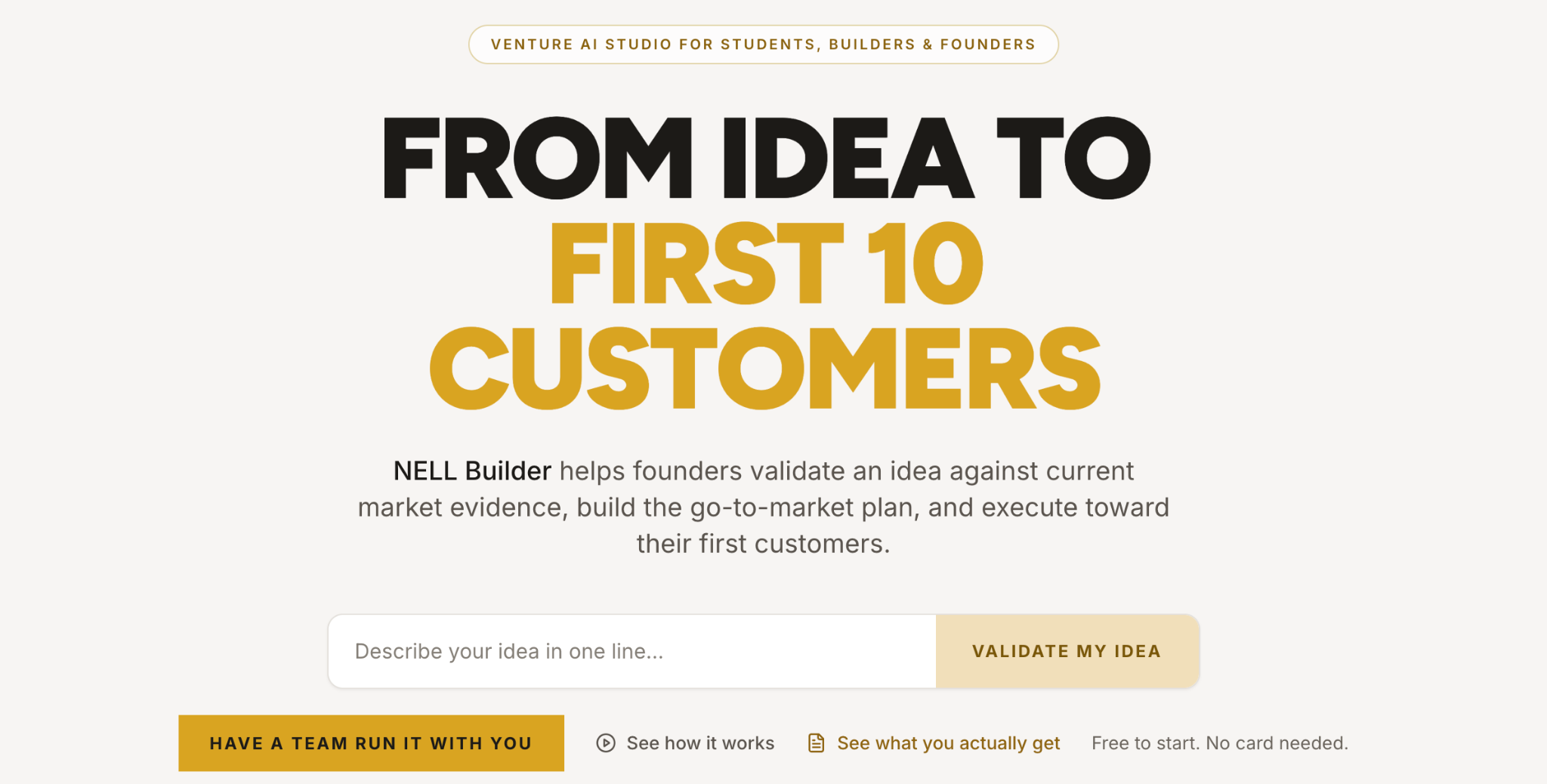
Start here, because the category label undersells what this is. NELL Builder isn't an idea-validation tool that does a few extra things; it's an idea-to-launch engine, and validation is one feature inside it.
Most tools on this list answer one question: is my idea any good? NELL answers that one with sourced rigor, and then answers the one that matters next, so what do I do about it, with the pricing, positioning, build spec, outreach and first leads to go build.
Here's what that looks like in practice, tier by tier.
Free Tier
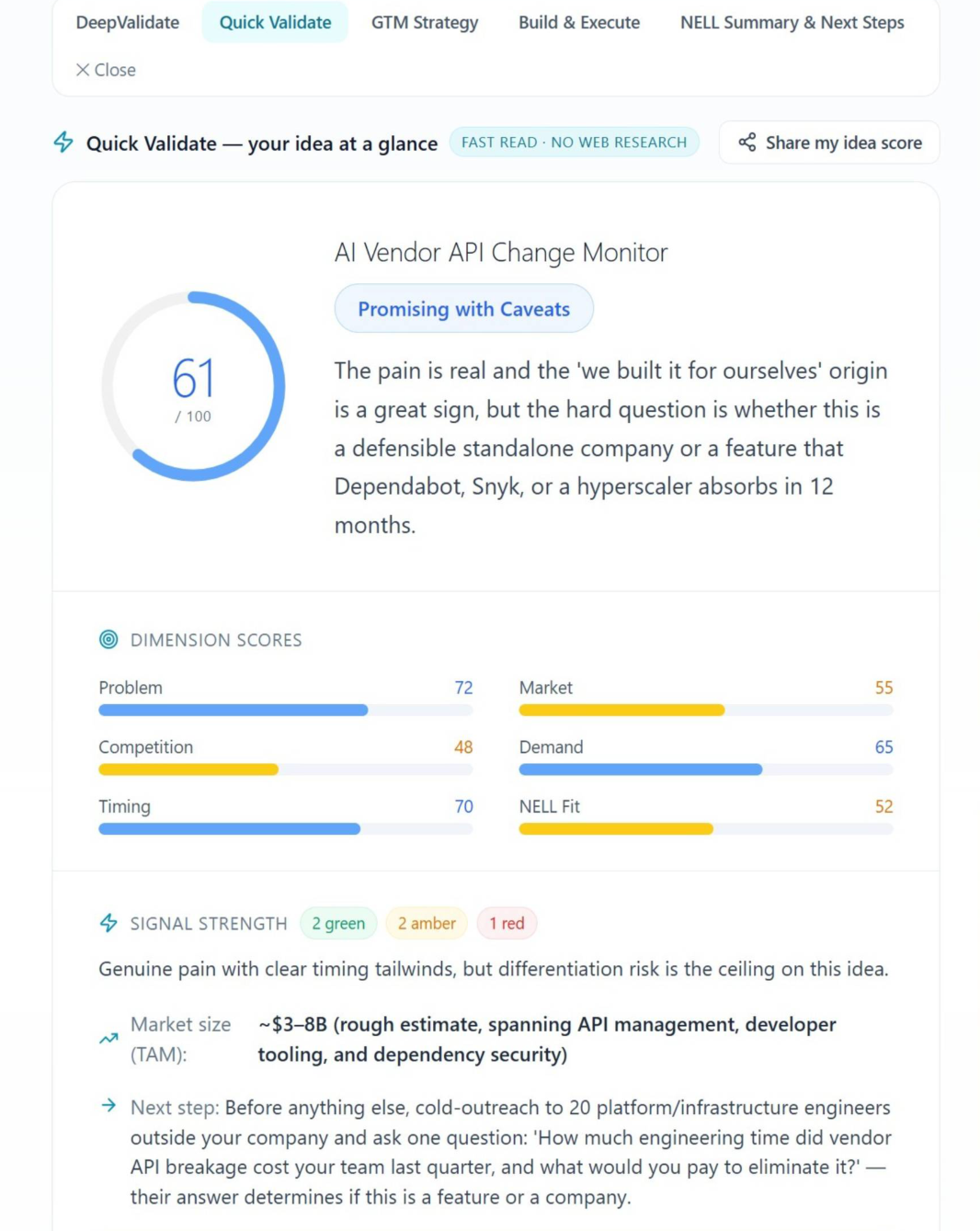
Quick Validate (Free): Your Idea at a Glance
Before you pay a cent, Quick Validate gives you an instant read; a fast, no-web-research score drawn from what NELL already knows. You get a 0-100 viability score, a dimension-by-dimension breakdown, a green / amber / red signal read, a rough market size, the single biggest unknown to go resolve, and a concrete next step. It's the honest gut-check that tells you whether an idea is even worth a deeper look, and it costs nothing.
Deep Validation
DeepValidate ($49): the Same Read, Now Sourced and Deep
When an idea clears that bar, DeepValidate is the first paid tier and this is where the live web research kicks in. On its own it's a genuinely deep validation, more than most tools on this list give you at any price. Six things it hands you, and what each is actually for:
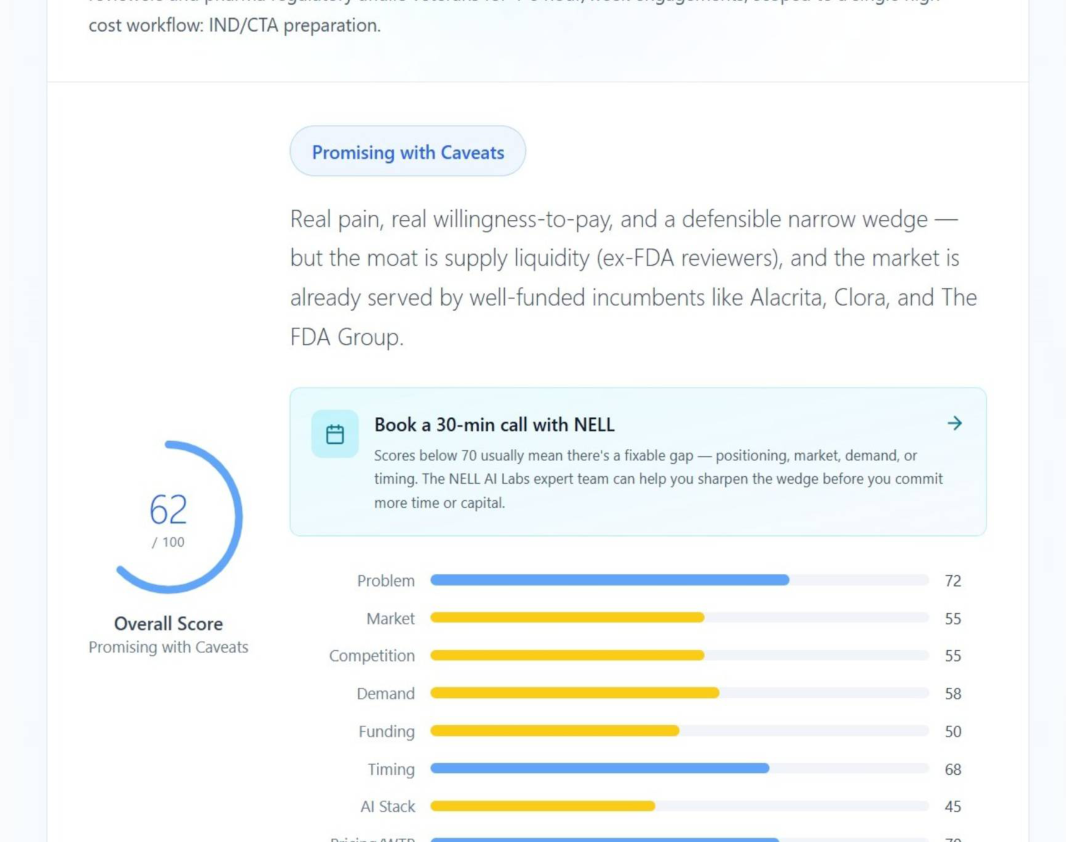
The verdict, scored and sourced. A 0-100 score across 11 scored dimensions in 5 pillars: problem, market, competition, demand, funding, timing, AI stack, pricing, unit economics and more, each with a one-line brutal-truth note. You get an honest read on exactly which parts of your idea are strong and which are weak, before you commit a day to building.
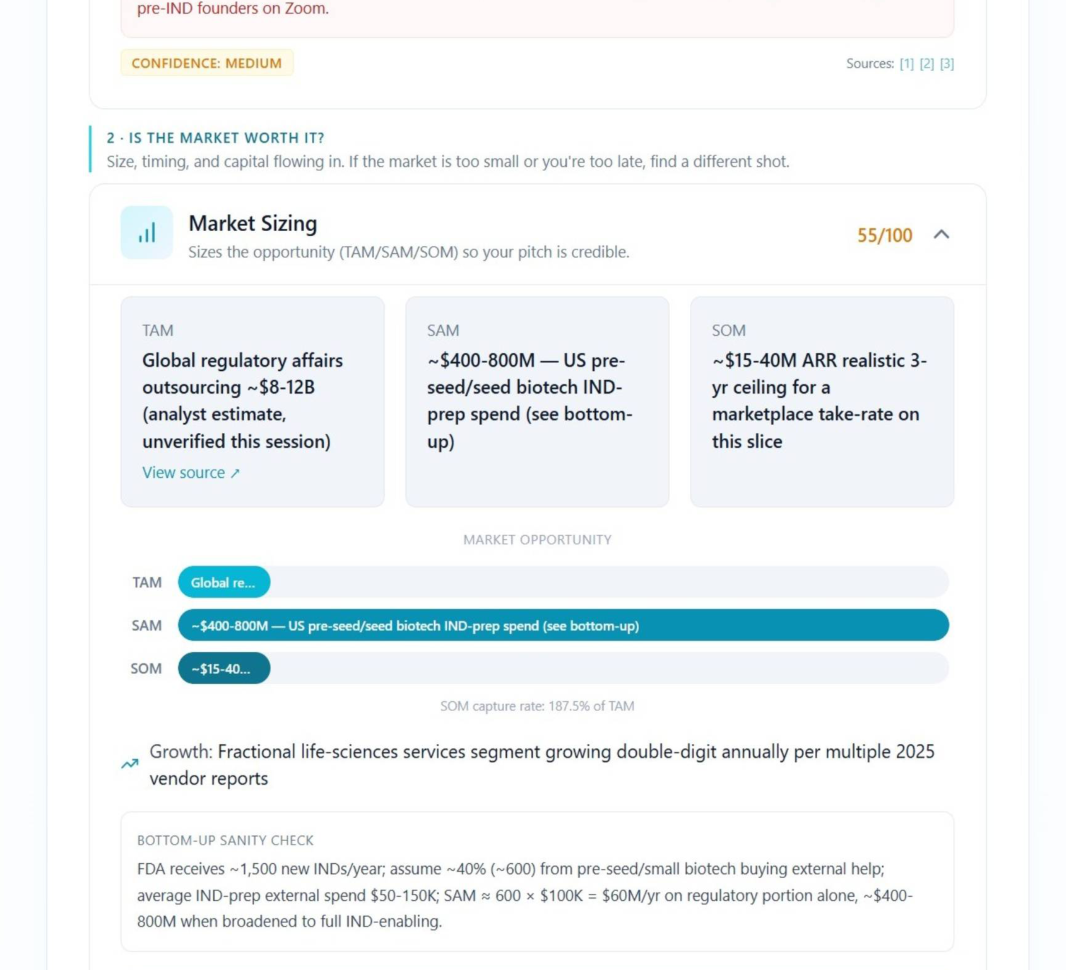
How big the market actually is. TAM, SAM and SOM, each cited to analyst reports and filings, plus a bottom-up sanity check. You get a market number you can defend in a pitch and a realistic revenue ceiling, instead of a vanity figure that collapses under one hard question.
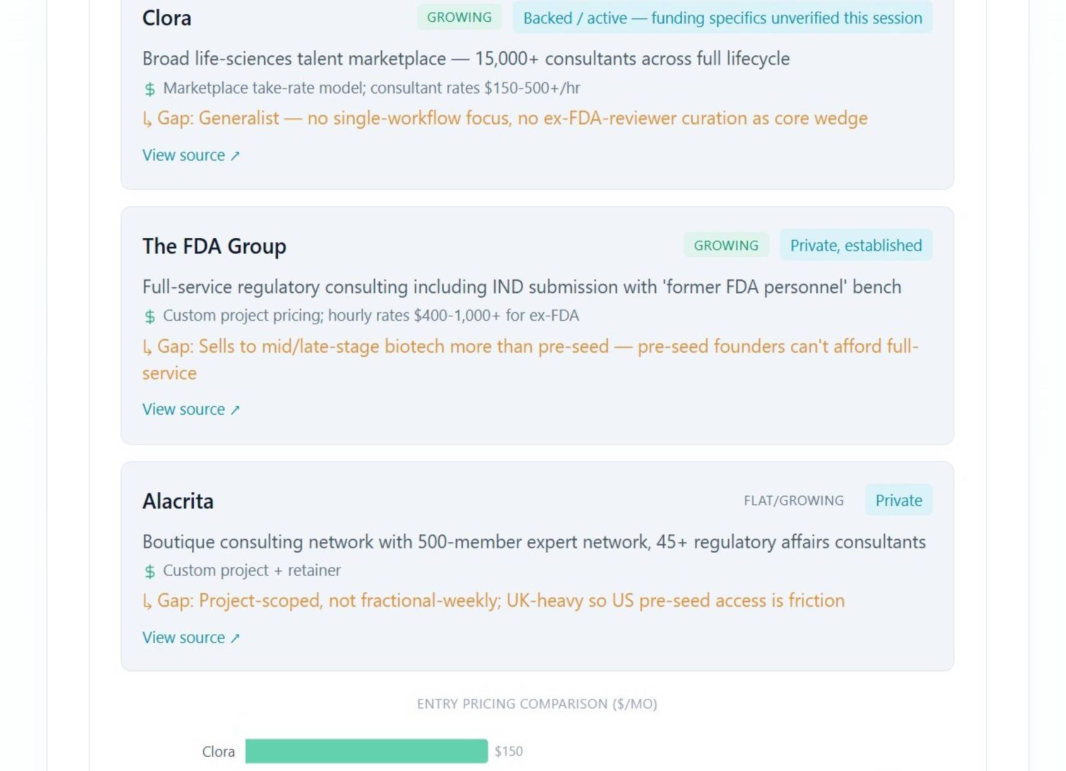
How crowded it is, and the lane you can own. A named competitor matrix of 8-12 players, plus a white-space map that sorts the market into contested, emerging and clear lanes. You get a straight answer on whether the space is crowded and, more useful, the uncontested lane you could actually win.
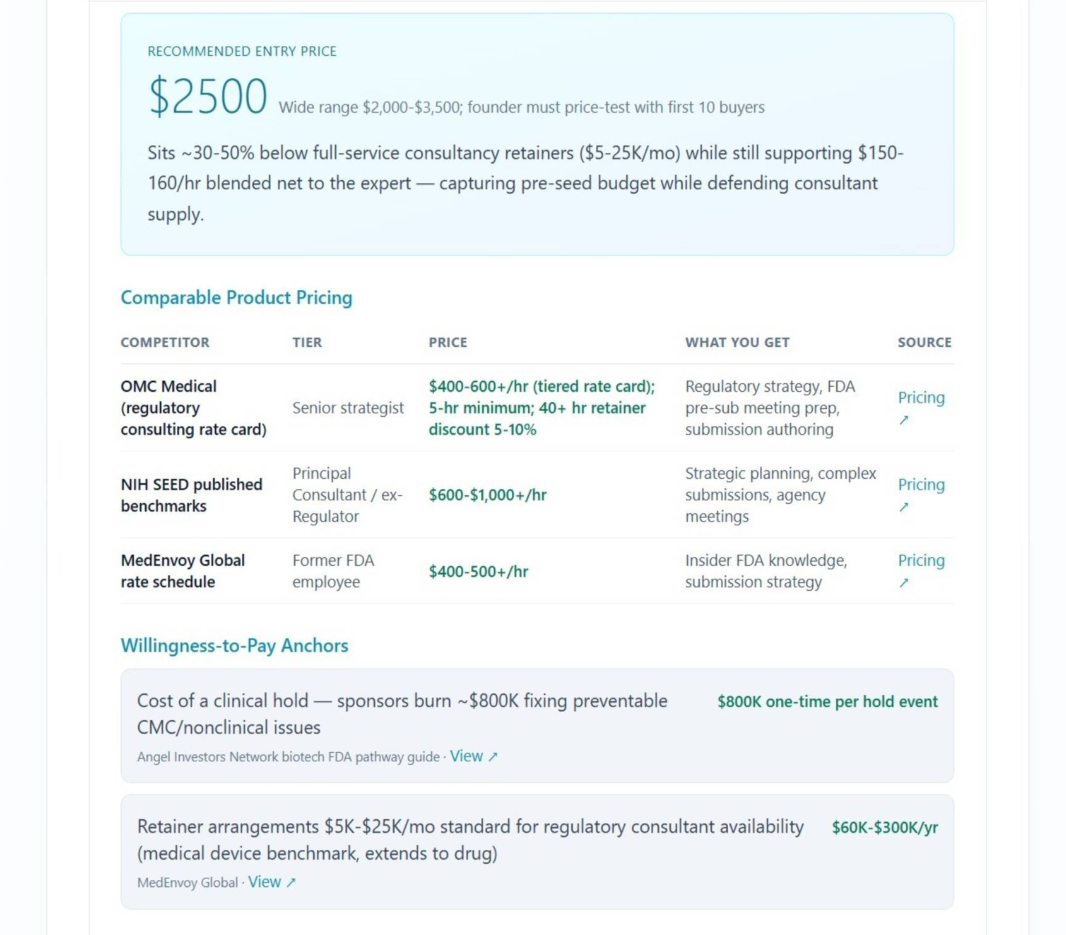
What people will actually pay. Pricing benchmarks, willingness-to-pay anchors, price-sensitivity signals and a recommended revenue model. You get a defensible entry price grounded in what comparable buyers already pay, not a number you picked because it felt about right.
The uncomfortable truths, in writing. Every section ends with a brutal-truth line, a confidence level and its sources, and it flags the gaps in its own evidence. You get a tool that refuses to let you fool yourself and shows its receipts, so you can check them.
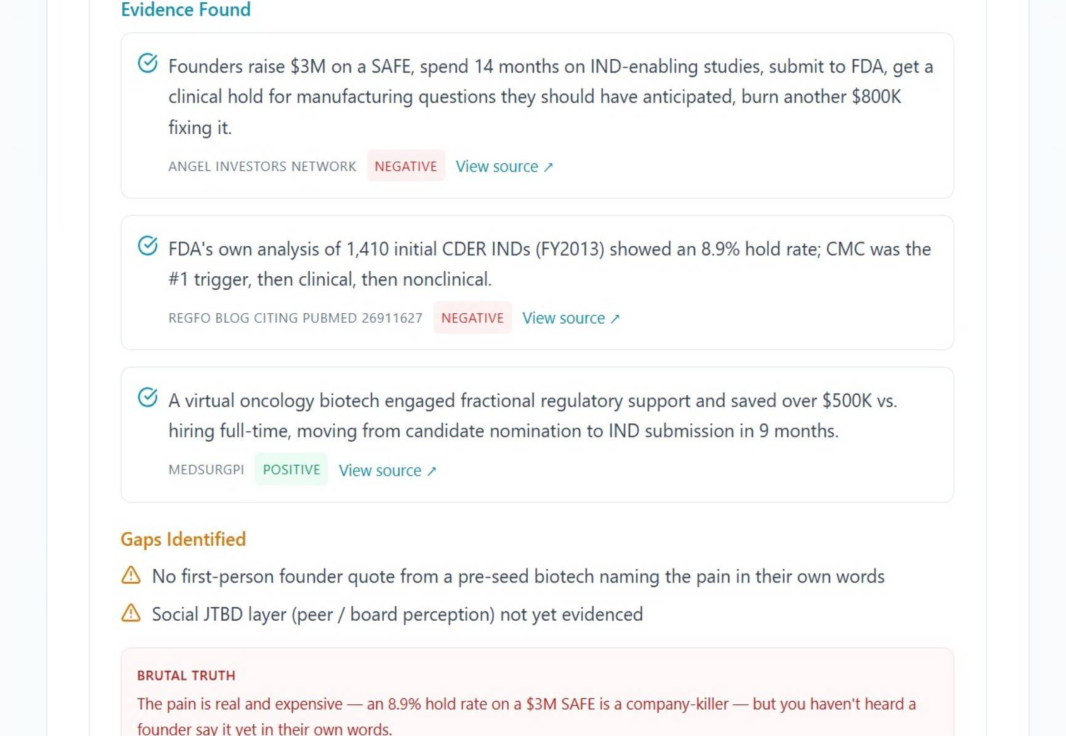
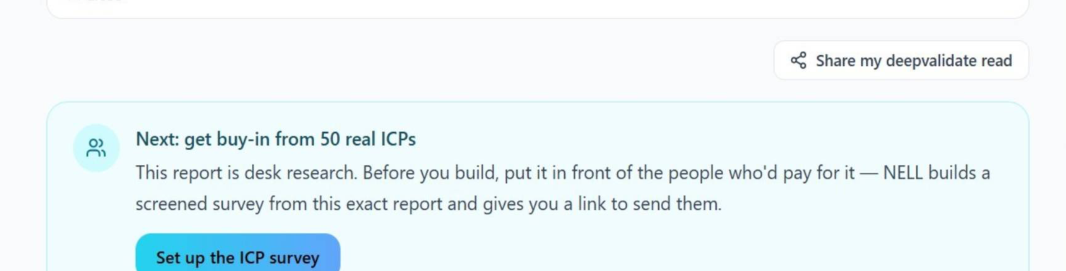
Real buyer evidence, not just desk research. From your report, NELL builds a screened buyer survey, hands you one link to send to real potential customers, and returns their answers as a scored go/kill verdict. You get signal from the people who'd actually pay, the one thing AI reading the web can't give you.
It also models your unit economics (CAC, LTV, payback), checks whether your AI stack is feasible with a technical risk register, reads market-and-compliance region by region (US, UK, EU, the GCC, APAC, LATAM), and ends with an investor-ready PDF you can forward as-is.
Go-To-Market
Launchpad ($149): the Verdict Becomes a Plan
One rung up, NELL Builder turns the validated idea into a 21-section go-to-market strategy in a single document. This is where it stops being a validator entirely and starts acting like an operator.
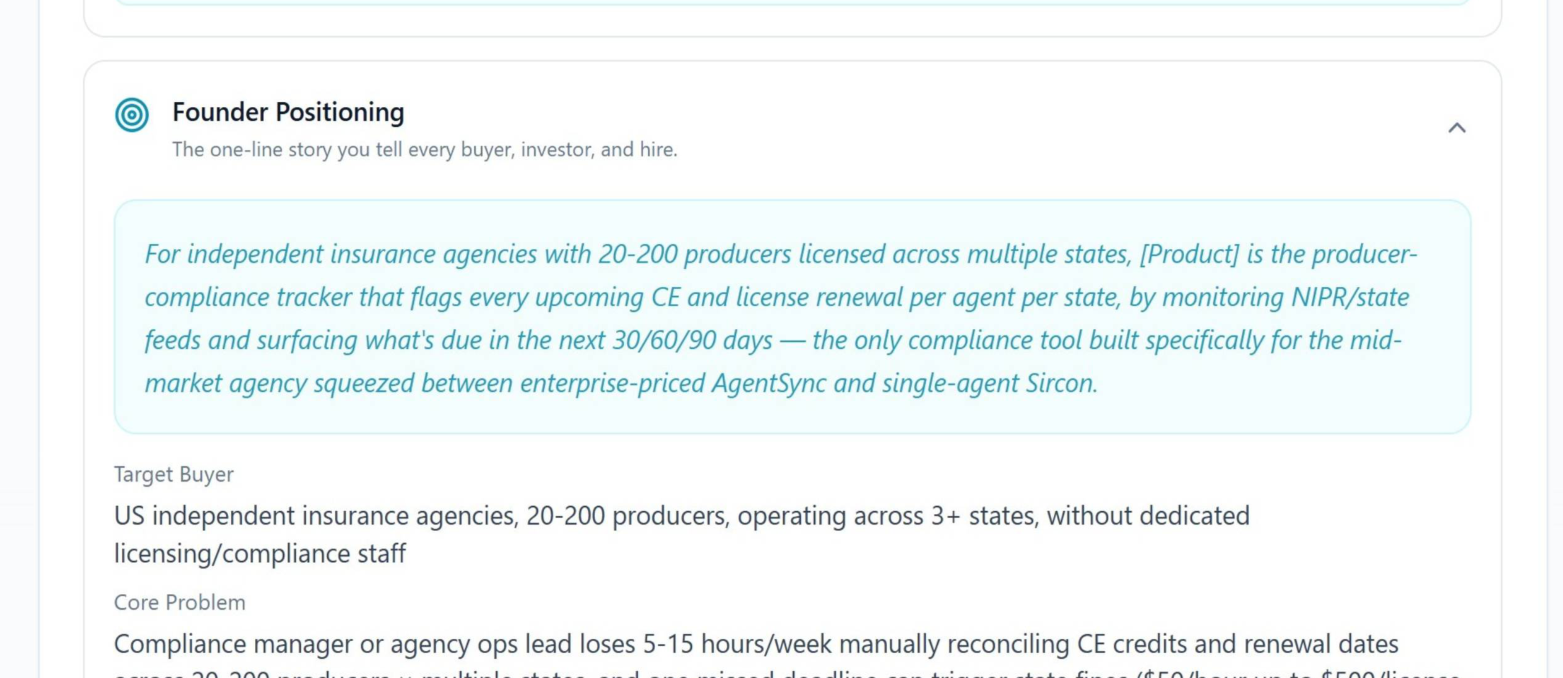
Your positioning, and the words to say. A one-line positioning statement plus three message variants ready to A/B test. You get the exact language to put in front of buyers, investors and hires and three versions to test, rather than one guess you hope lands.
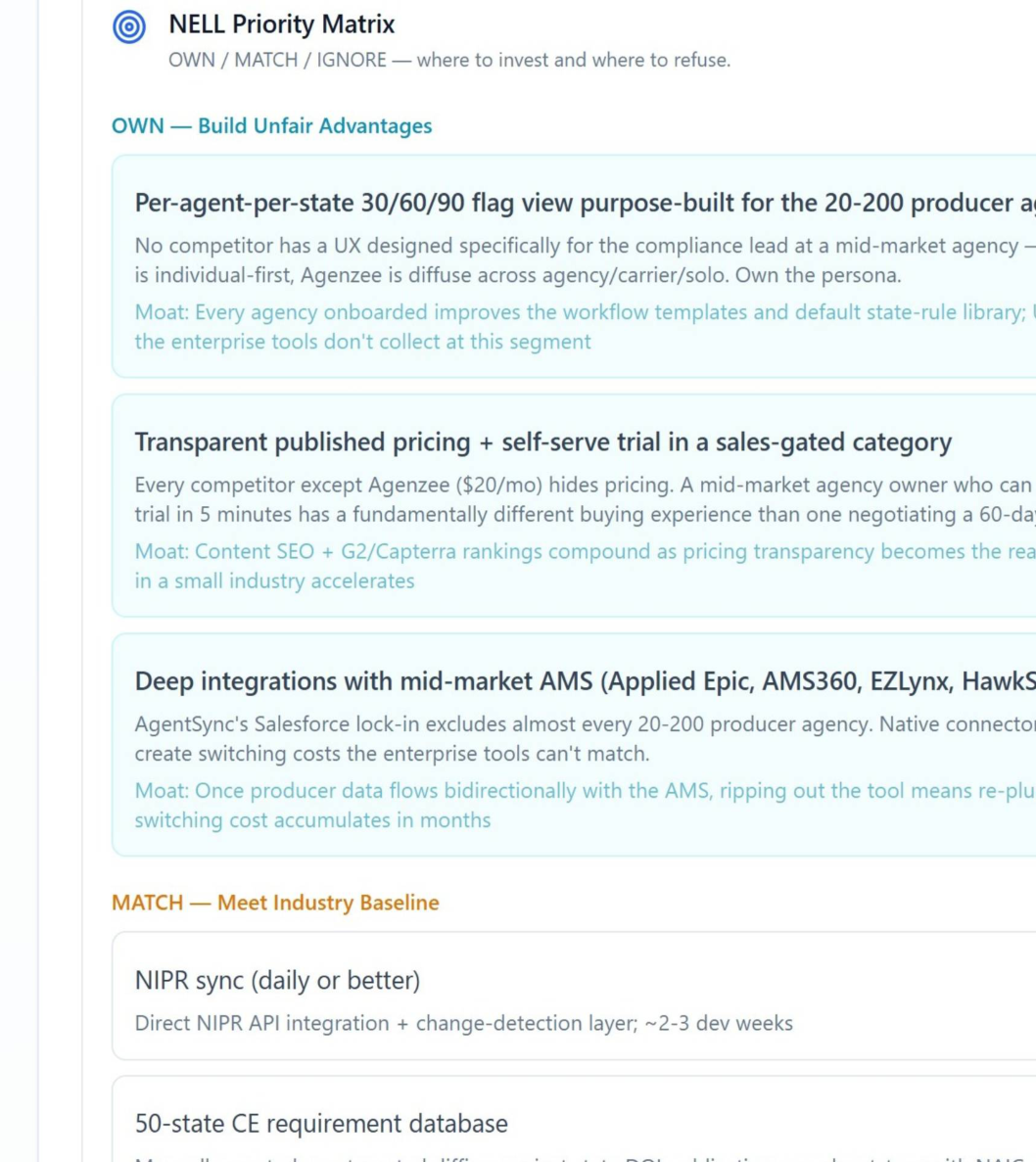
Where to invest, and where to refuse. An OWN / MATCH / IGNORE matrix that sorts every possible feature into build-an-advantage, meet-the-baseline, or don't-touch. You get permission to ignore the busywork and pour your limited time into the two or three things that actually build a moat.
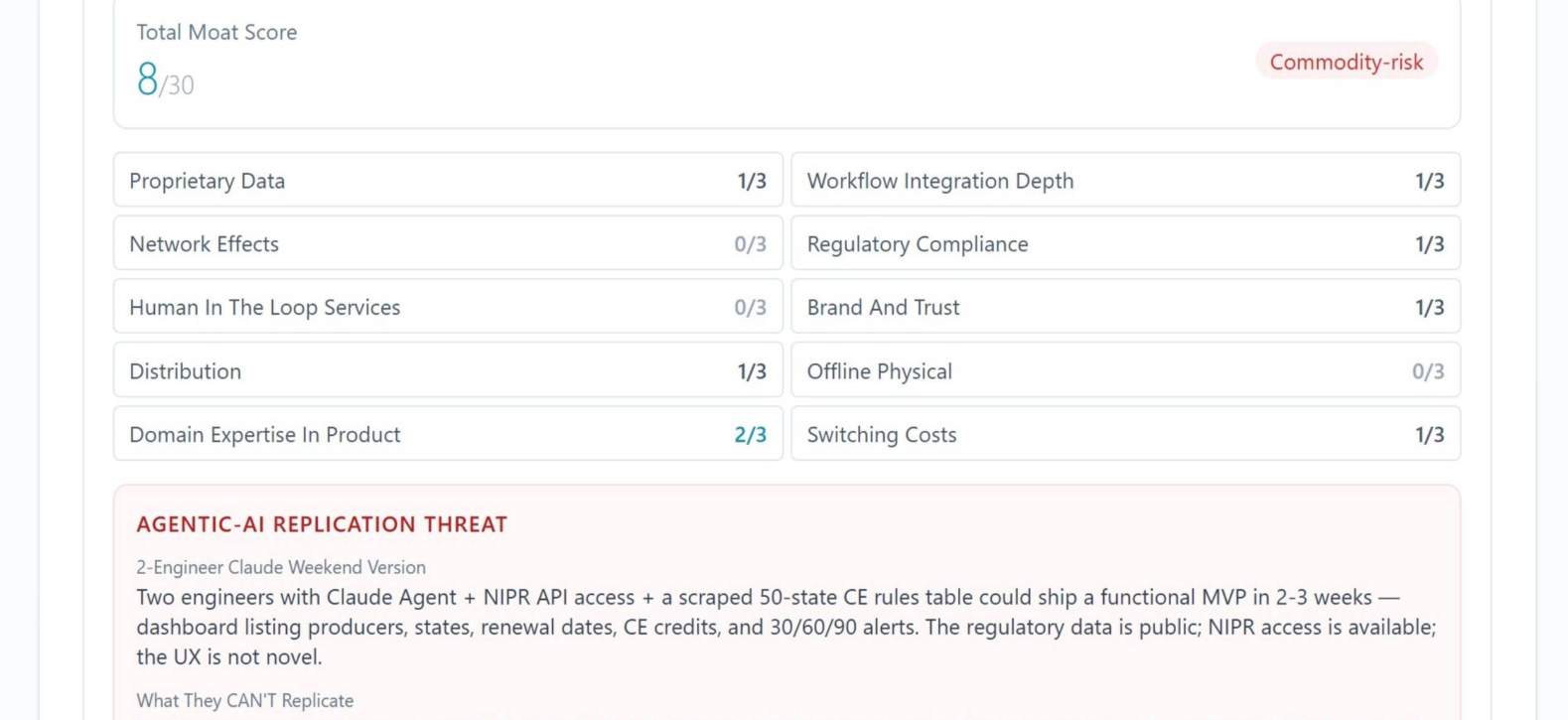
Whether your moat survives an AI clone. A defensibility audit that scores your moat out of 30 and models exactly how a two-engineer team could clone you in a weekend and what they couldn't copy. You get an honest read on how defensible you really are, and a punch-list of what to build to become hard to copy.
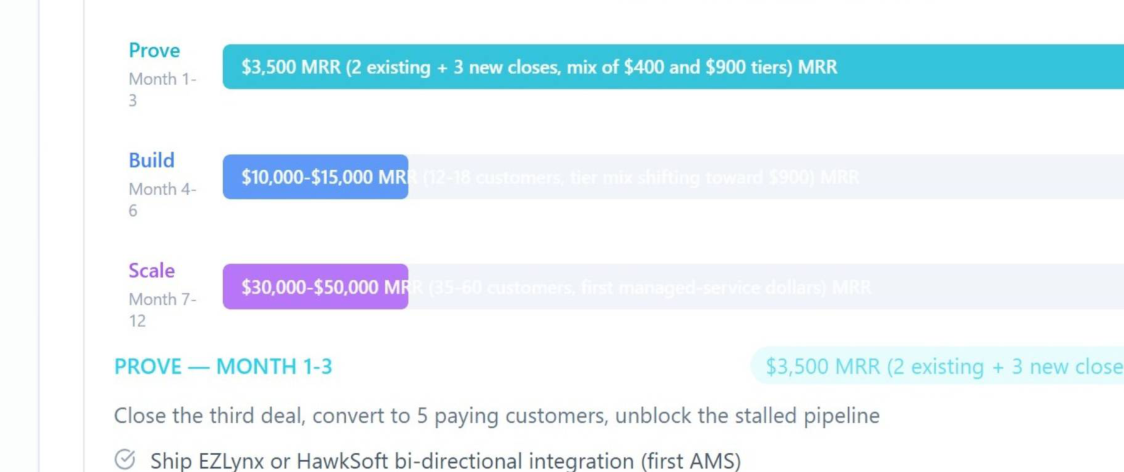
Your first ten customers, and a dated plan to get them. A design-partner playbook with a named target list and intro scripts, a channel mix with CAC per channel, and a Prove-Build-Scale roadmap with weekly milestones and MRR targets. You get named people to contact, the words to reach them, and a plan with numbers on it, not "now go find customers."
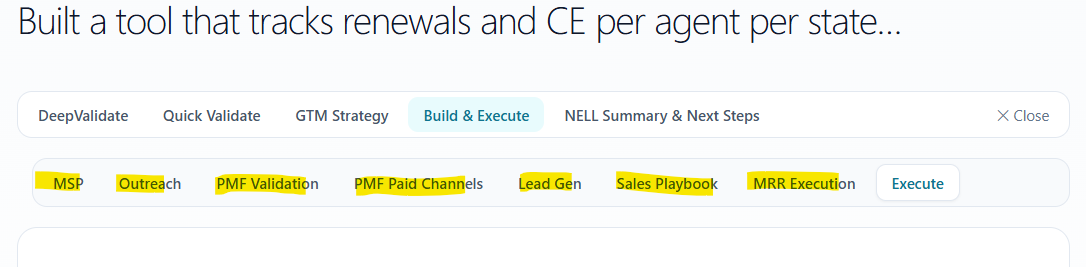
It also specs your Minimum Sellable Product with a clickable wireframe so you know what to build first, sets a pricing and tier structure, writes a founder narrative and pitch one-pager, and pulls 30 verified leads on demand ($35 unlocks up to 1,000).
Execution
Pro Builder: Operators in the Trenches
The seven playbooks that run the launch, plus humans to run them with. Pro Builder adds the execution playbooks, PMF, Paid Channels and a MEDDIC sales playbook, a hand-researched named lead list, a 26-week MRR execution tracker with weekly recommendations, 1:1 operator support over Slack, and a path into a 12-week incubation if your idea scores 75+. You get the machinery to actually run a launch, not just the plan for one.
Plans
The Tiers at a Glance
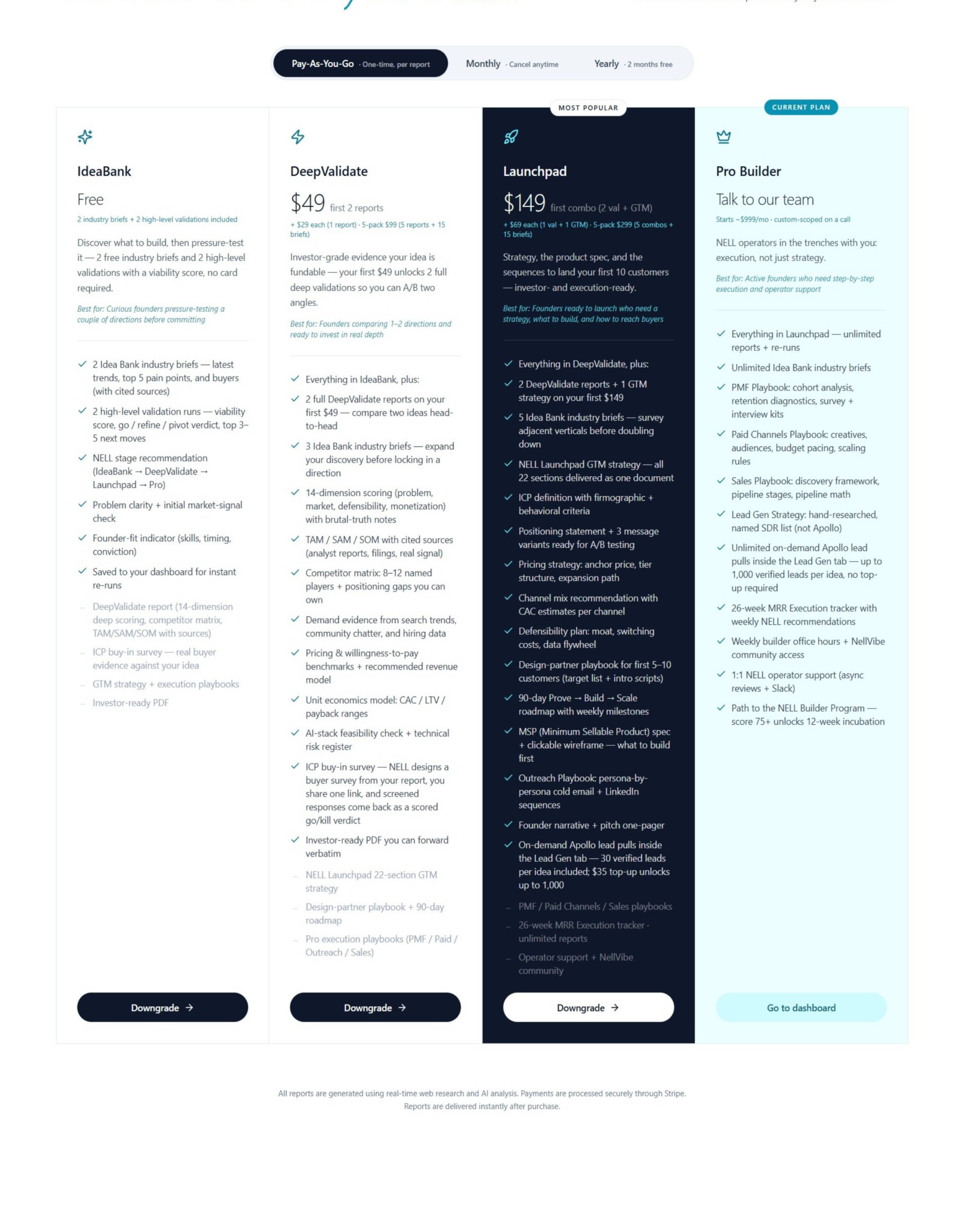
Where it loses. For the single deepest pure-validation document, Preuve (next) is at least NELL's equal, draws on more raw sources, and is cheaper for one report ($29 versus a $49 first purchase for two). If the verdict is all you want, Preuve is the better buy. NELL Builder wins the list because it doesn't stop there. Free tier, $49 DeepValidate, $149 Launchpad, Pro Builder for operators.
02Preuve AI (26/30)
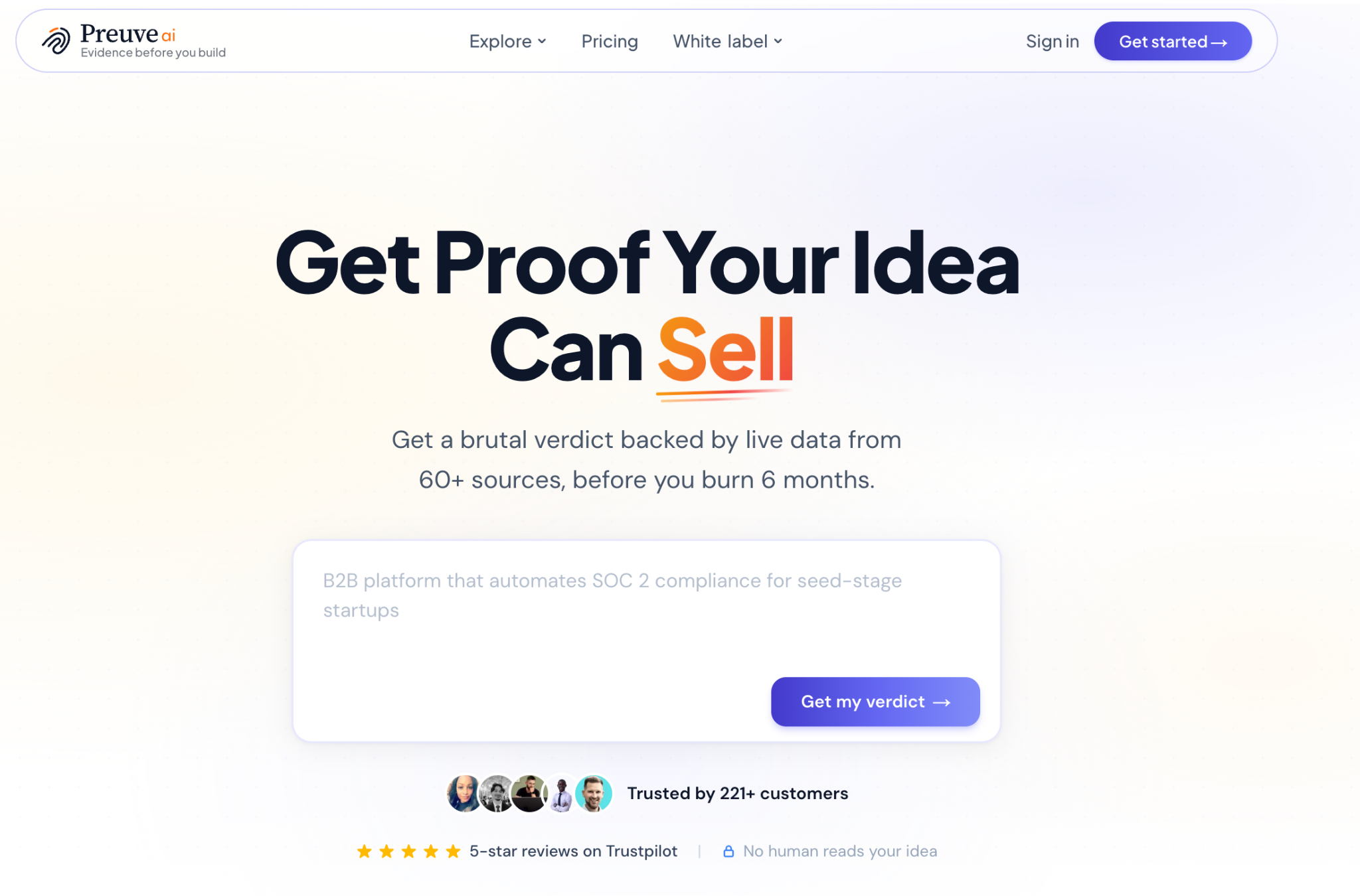
What it does best. Pure sourcing, better than anyone. Ten AI agents scan 50-plus live sources, cross-check until two models agree, and link every claim. The $29 Founder Report gives 15 sourced sections, TAM/SAM/SOM, up to 15 named competitors with funding and pricing, three pivots and a Founder Fit score, and there's a free scan. By the founder's own benchmark, 8 in 10 ideas score below 70; it won't flatter you.
The limit. It validates and stops (its founder says so), and it's a young, solo-run operation with a thin review base. If the verdict is the whole job, it's arguably the best buy on this list.
Pricing. Free Reality Check scan; Founder Report $29 one-time (15 sections); Radar Pro monitoring $19/mo; Investor Package $499. No subscription on the core report.
What users say. Small but real independent footprint, around a dozen public reviews across Trustpilot, Product Hunt and There's An AI For That. It's run in the open by one founder (Vincent, formerly Test Your Idea) who publishes his own limits and a benchmark showing roughly 82% of ideas score below 70. The trust comes from the linked sources, not the review count.
03DimeADozen.AI (23/30)
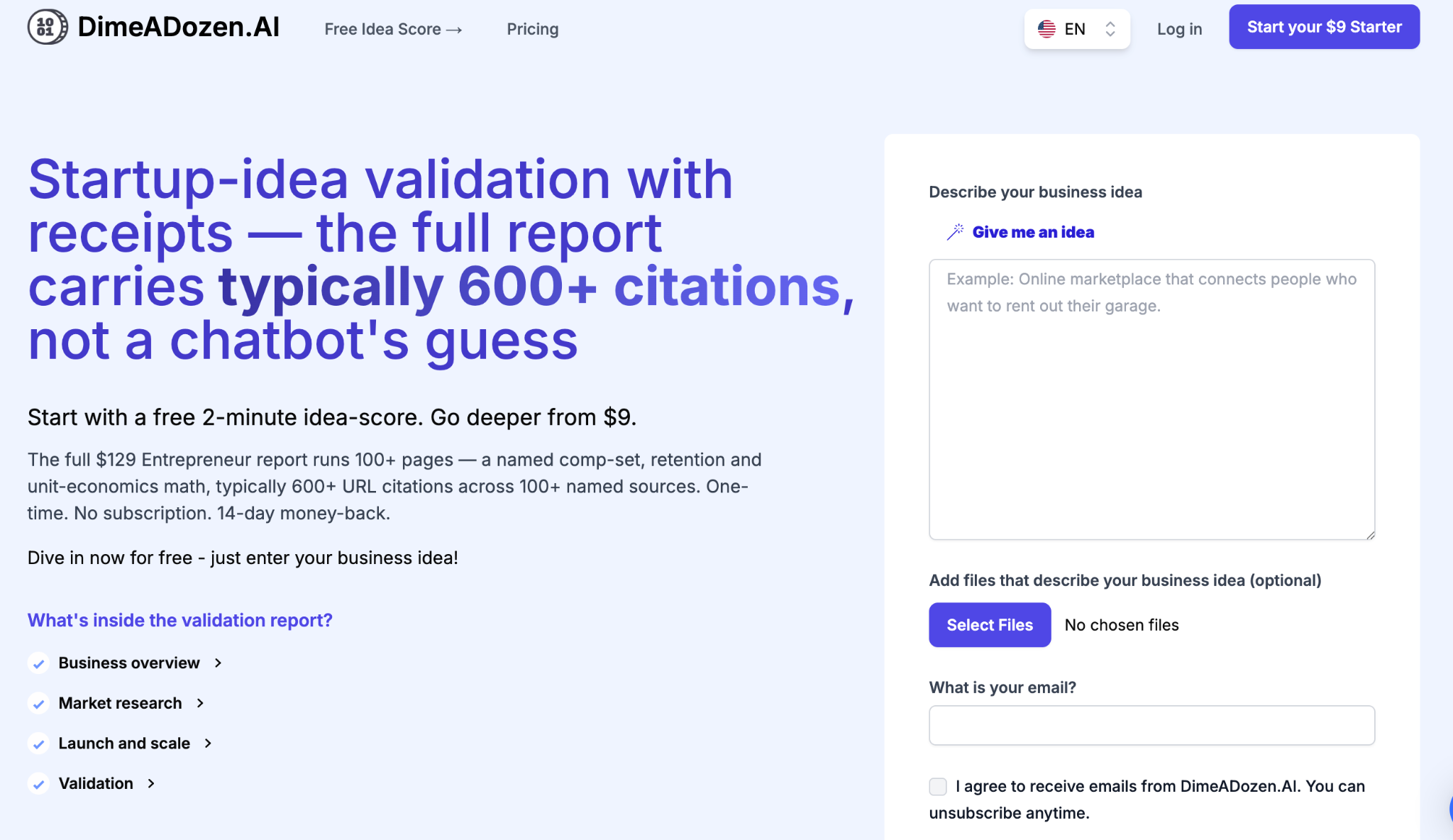
What it does best. The deepest single decision memo, from a more established name, named competitors, retention maths from filings, unit economics, execution requirements, all citation-backed. Buy once, keep it.
The limit. Report-style, and live-source breadth arguably narrower than its language suggests.
Pricing. Free 4-dimension idea score (no card), then one-time and no subscription: $9 Starter (a 7-section teaser), $129 Entrepreneur (the full 200-plus-page report with 800-plus citations across 140-plus sources), $179 for a 3-pack. 14-day money-back, credits never expire.
What users say. The most-referenced of the buy-once report tools (it claims 85,000-plus users) and it turns up in nearly every comparison roundup. Independent star-rating reviews are thin, so judge it on the inspectable sample report rather than the user count.
04IdeaProof (23/30)
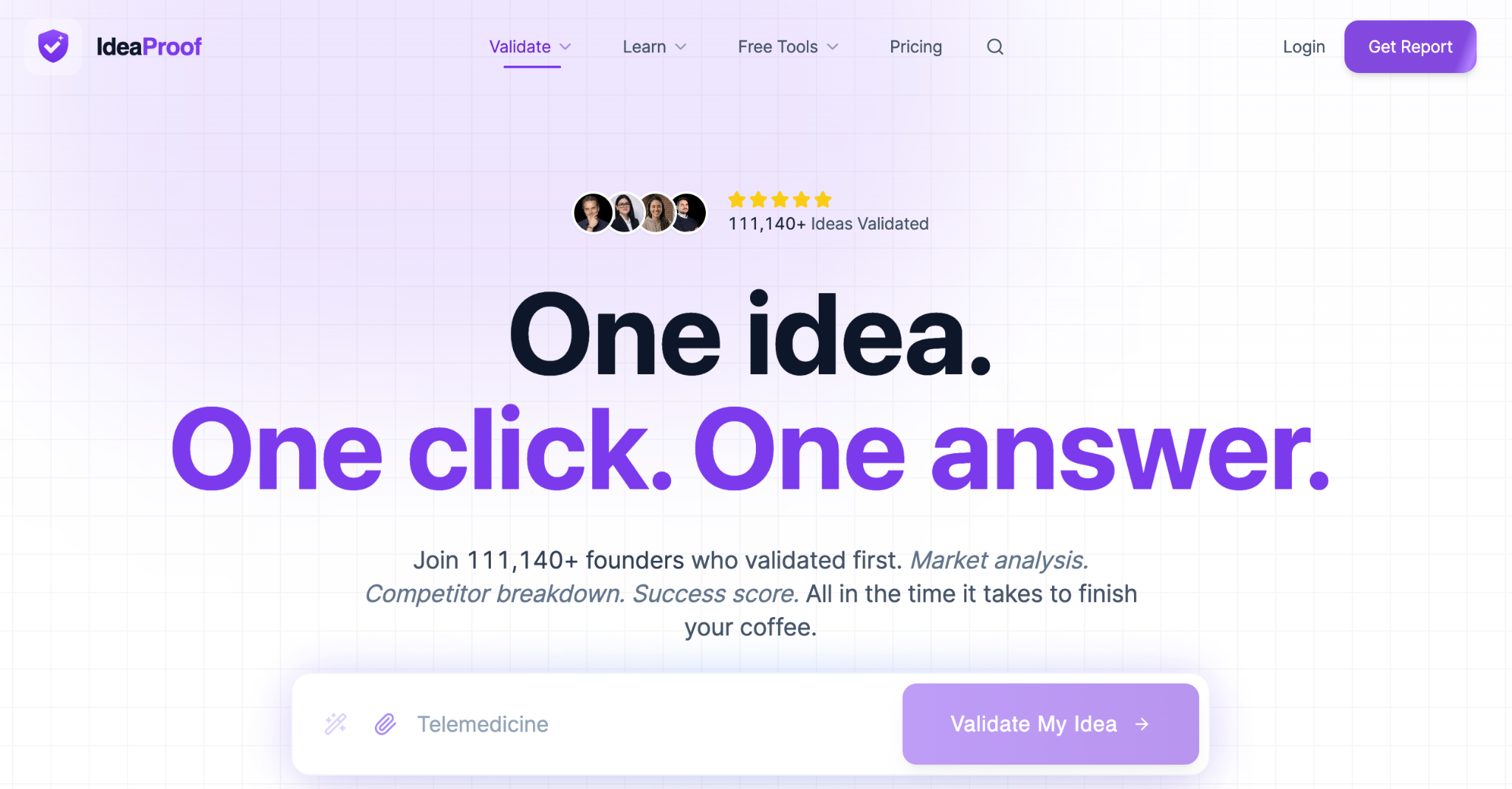
What it does best. Breadth and speed in one workspace, a multi-model score in minutes, TAM/SAM/SOM, competitor SWOT, an investor-ready plan and a brand kit, roughly 90 free credits.
The limit. By Preuve's teardown, thin sourcing (about five sources), an accuracy claim with no published method, and no third-party reviews as of mid-2026. Broad, not deeply verifiable.
Pricing. 90 free credits (about two full validations, no card), then one-time credit packs. Starter EUR 19.99 (150 credits), Builder EUR 49.99 (700), Founder EUR 99.99 (1,500). A validation costs 40 credits, a market analysis or business plan 100 each; credits never expire.
What users say. No independent reviews at all; zero on Trustpilot, G2 or Capterra as of mid-2026. It advertises "89% accuracy" and "10,000+ users," but neither is backed by a published method or verifiable reviews, and competitors (conflicted, but specific) peg its average score around a feel-good 78/100.
05WorthBuild (22/30)
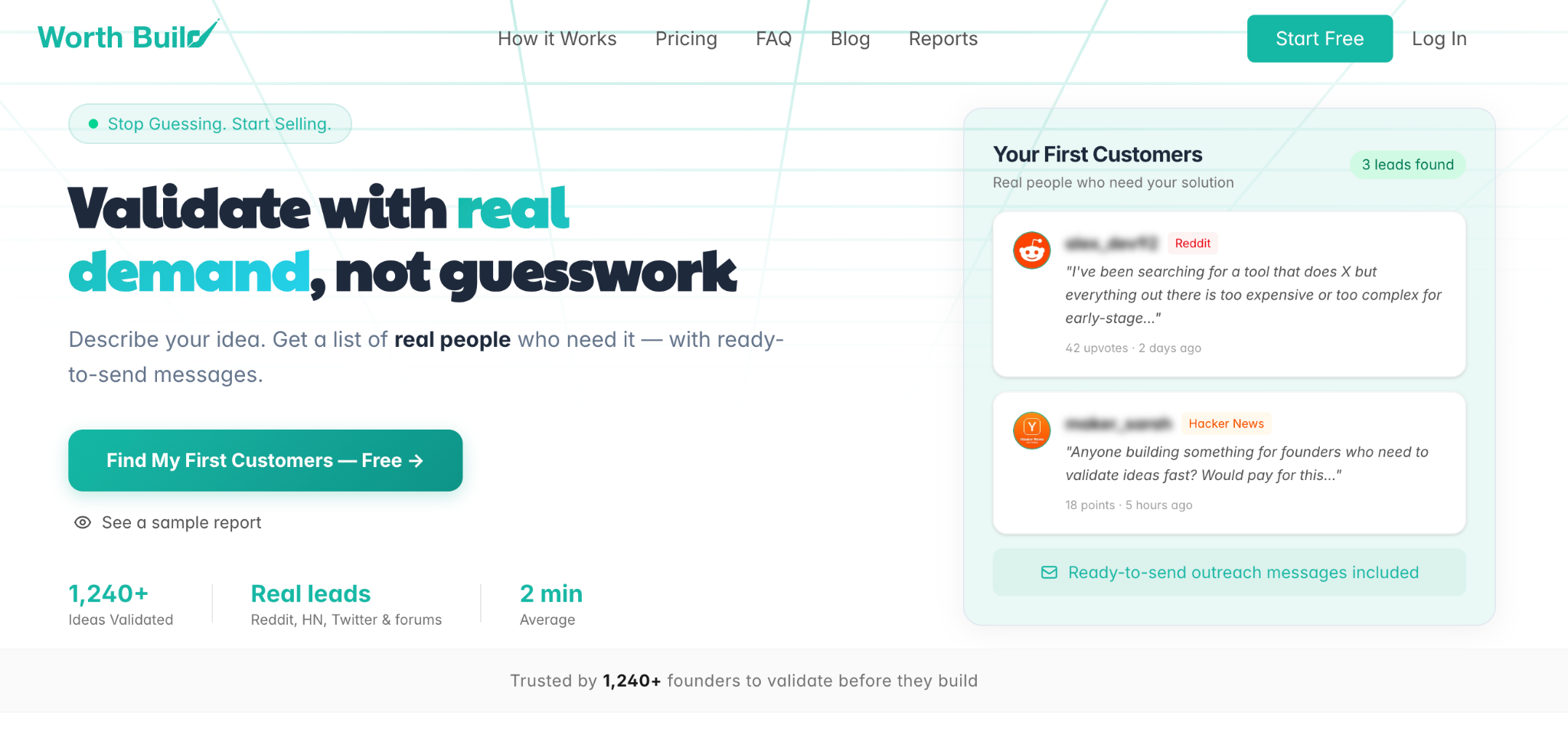
What it does best. Cheap reports plus a lead-discovery layer that names real potential users on Reddit, HN and Twitter with outreach templates.
The limit. Shallower validation, unpublished lead methodology. Verify the leads.
Pricing. Around $5 a report, or $20 for five, with one free report a month. It's early-stage and the pricing isn't heavily published yet.
What users say. One of the few here with genuine organic enthusiasm; founders on Reddit's r/SaaS report its output matched months of their own manual research, and the "Gold Mine" and "What's Missing" sections get named specifically. It's small and early, so read that as promising rather than proven.
06Trend Seeker (21/30)
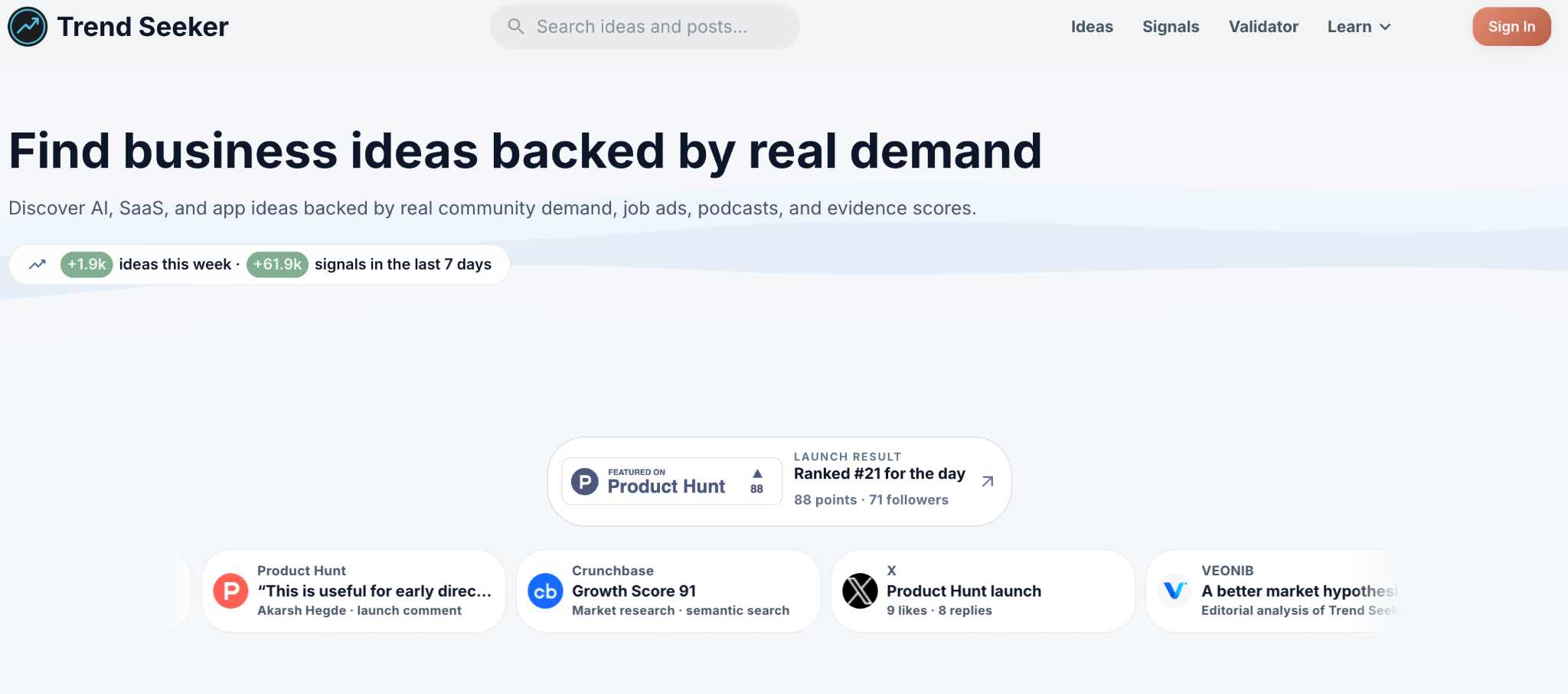
What it does best. A focused, cheap demand read, real search and community signal on whether people actually want this with a free tier.
The limit. Single-job. No real sizing, competitive depth or economics on its own.
Pricing. Free public validator; premium around $9.99/mo. It matches your idea against 50,000-plus real Reddit posts, scores demand by volume and similarity, and links the actual threads.
What users say. Newer and lightly reviewed, but its core claim is self-verifying: it links the actual Reddit threads behind the demand score, so you can check the evidence yourself rather than trust a rating.
07VenturusAI (20/30)
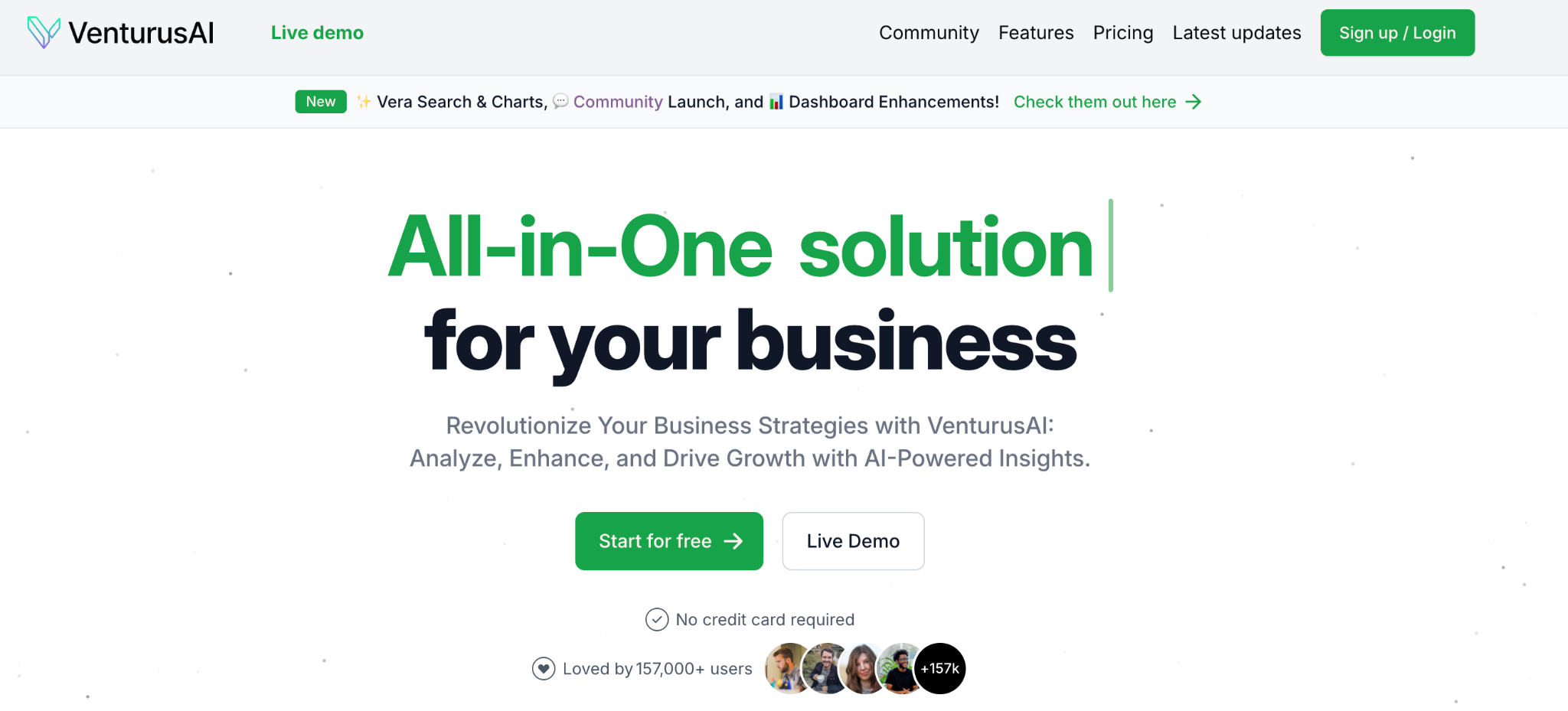
What it does best. A free, fast framework pass, SWOT, PESTEL, Porter's over your idea. A structured free first look.
The limit. No live sources; reasoning over training data, so treat the confidence with care.
Pricing. Free forever (2 standard reports a month; advanced reports $10 each), Pro $10/mo (10 standard plus 3 advanced reports, pitch-deck generation, dashboard), Agency custom.
What users say. A handful of positive but light reviews (G2 among them) praising the instant, structured feedback. Testers agree it's useful for direction and frameworks, not a substitute for real market data, it's GPT-generated with no live sources.
08ValidatorAI (19/30)
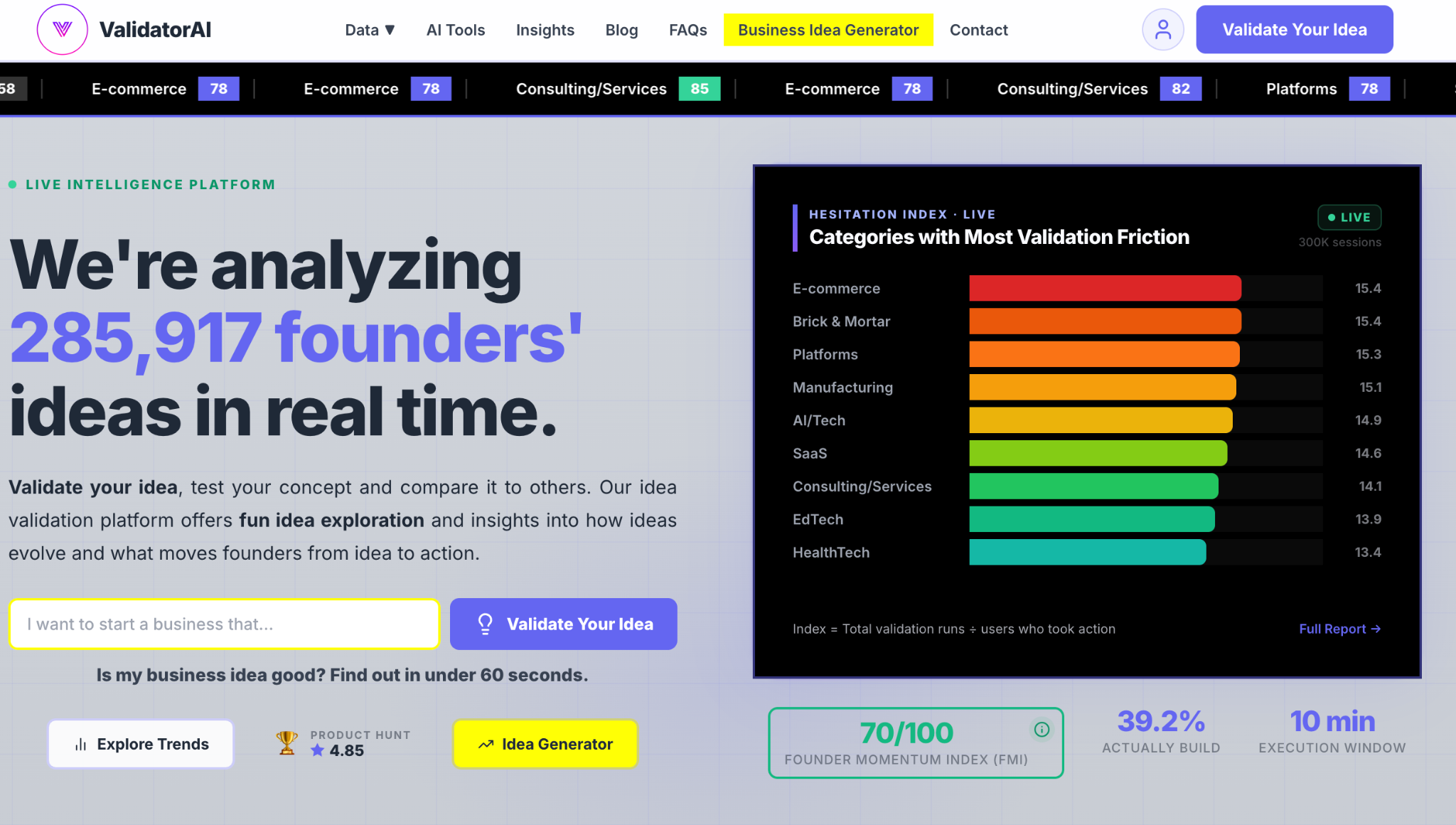
What it does best. The friendliest on-ramp; best SEO, a conversational (and voice) coach, a free tier. A comfortable first step.
The limit. No live sources and a tendency to tell most founders their idea is fine. A gentle coach, not a real test.
Pricing. Free tier (capped, but a genuinely useful gut-check); paid PRO roughly $25-$39/mo, though published prices are inconsistent across the site (tiers from $15 to $120). The paid plan mostly unlocks longer conversations.
What users say. Thinner than its traffic suggests, roughly one Trustpilot review, and it barely comes up organically in the founder communities it should dominate (a relevant r/EntrepreneurRideAlong tools thread didn't mention it at all). It had its moment in early 2023; interest has faded, and the average submitted idea still "passes."
09FounderPal (18/30)
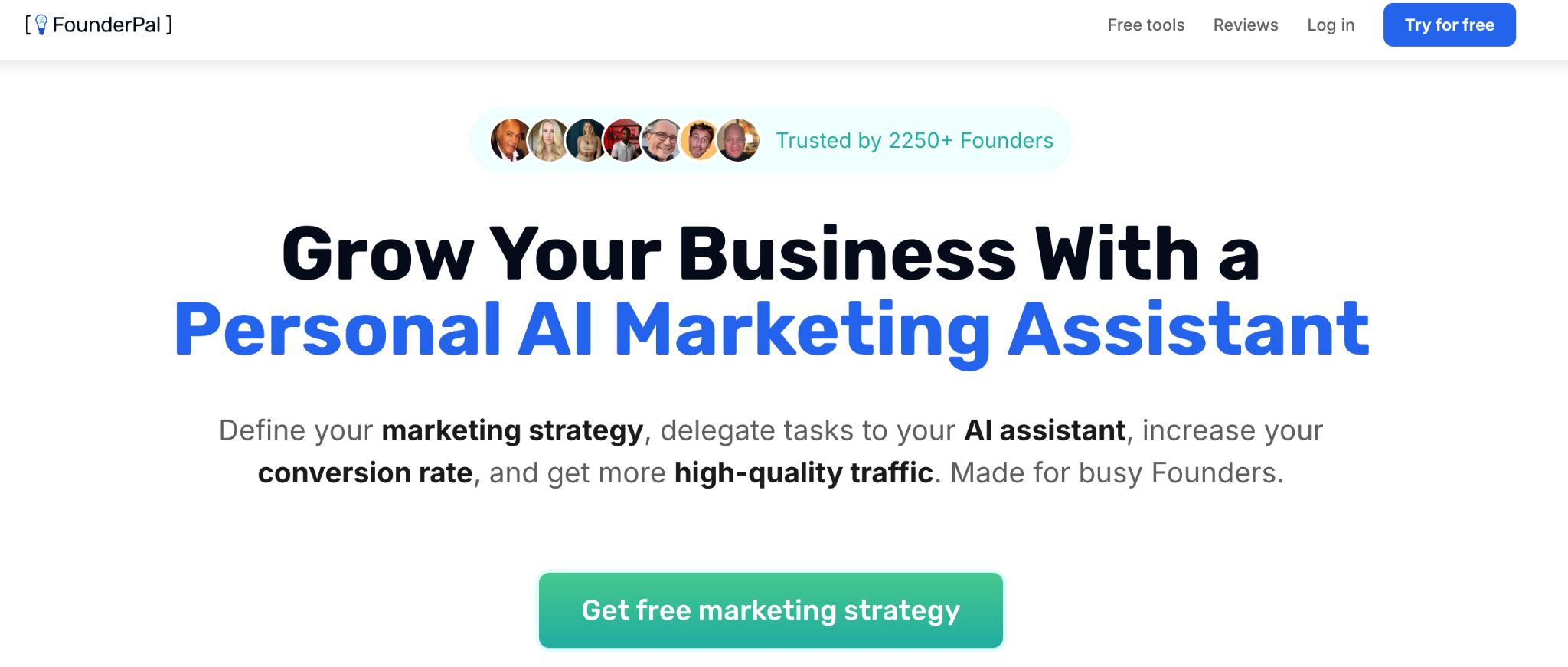
What it does best. Free and instant. Its idea-validator and marketing tools spit out audiences, value props and a persona in seconds, handy for a five-minute gut-check or some marketing scaffolding.
The limit. No sourcing and very shallow, it's a fast generator, not a validator. Fine for a first spark, not for a build decision.
Pricing. Completely free; a single-page idea-validator inside a suite of free marketing tools. There is no paid validation tier.
What users say. It's a free utility, so there's no real independent review base. Fine for a quick spark; shallow and unsourced for a real decision.
10IdeaBuddy (16/30)
What it does best. Planning-first; a business model canvas, a one-page plan and simple financials, with questionnaire-style validation attached.
The limit. A planning tool, not a validator; its own terms disclaim accuracy and the validation is self-reported, not sourced. Ranked last because it's answering a different question.
Pricing. A 15-day free trial with full access, then paid monthly plans (roughly $15-$50/mo by tier). It's an established product, around since 2019.
What users say. The most genuinely reviewed tool on this list; 4.6 out of 5 on Capterra across about 73 reviews, plus a spot on Forbes' Best Business Plan Software list for 2024. Users praise the guided structure, the AI suggestions and the value; common gripes are the business-plan design, financials that don't link to other sections, and weaker competitor and market-trend analysis.
One You’ll See on Older Lists
GummySearch, the Reddit demand-mining favourite, shut down commercially at the end of November 2025 after losing Reddit API access. If a 2026 list still recommends it, that list is stale. Trend Seeker, WorthBuild and Preuve cover pieces of what it did.
How to Actually Choose
| What you want | Best pick |
|---|---|
| If you want the verdict to turn into a plan. | NELL — sourced validation that carries into strategy, build and outreach. |
| If you want the single best validation document. | Preuve — deepest sourcing, cheapest for one report. |
| If you want the deepest decision memo from an established name. | DimeADozen. |
| If you want breadth and marketing assets in one place. | IdeaProof. |
| If want it cheap, with people to contact. | WorthBuild. |
| If you just need a demand check. | Trend Seeker. |
| If you want a free structured (or instant) first look. | VenturusAI, or FounderPal for speed. |
| If you mostly want a plan and financials. | IdeaBuddy. |
The single rule underneath all of this: if a tool can't show you where a number came from, treat it as a guess in a nice font. The top of this list earns its place on sources and honesty, not confidence. Run your idea through two of them, believe the one that's willing to tell you no, and verify whatever you build on.
Keep reading